General
5 min
How Much Does It Cost to Print in India? (Xerox, Colour & More)
How much does it cost to print in India? The honest answer is: it depends entirely on where you go — and that's exactly the problem. Printing prices across India are wildly inconsistent, swinging from around ₹3 to as much as ₹15 for a single black and white copy, often for no clear reason. This guide breaks down what printing really costs across different states and situations, the hidden charges that quietly inflate your bill, and what a fair price actually looks like.
How Much Does Printing Cost in India?
In India, a single black and white printout typically costs between ₹3 and ₹15, depending on where you go. The realistic minimum is around ₹3 per page, while colour usually costs ₹10 or more. Prices climb sharply near government offices, courts, and out-of-city campuses, where a single black and white copy can reach ₹10–15.
Why Printing Prices in India Are So Inconsistent
Printing in India is a largely unorganised market. There's no standard rate, no fixed pricing, and no real regulation — every shop simply charges what it wants. The price you pay often has less to do with the actual cost of a print and more to do with your location, how badly you need it, and whether there's another shop nearby.
The result is chaos. Walk into three different shops and you can genuinely get three different prices for the exact same black and white page. And in places where you have no choice — right outside an RTO, a court, or a residential campus — that price quietly climbs, because the shop knows you can't easily go anywhere else.
The Hidden Charges That Inflate Your Bill
It's not just the base rate. Several common practices push your printing cost higher than you'd expect:
The "first page" trick. Many shops charge a much higher rate for the first page and less for the rest — for example, ₹10 for the first page, then ₹3 for each page after. Print just one or two pages, and your per-page cost is enormous.
The minimum-charge trap. Some shops set a flat minimum — often around ₹20 — no matter how little you print. Whether it's 1 page, 2 pages, or 5, you pay the same ₹20. Need a single black and white copy? You're still charged for five. It's one of the most common ways a "cheap" printout quietly becomes expensive.
Upfront gouging near government offices. Print shops right beside RTO and court offices often charge a flat ₹15 for a single black and white copy — no discount, no logic, just a captive audience.
The "no other option" markup. Universities on the outskirts of a city, especially residential campuses, usually have just one or two nearby shops. With no competition, ₹10 for a single black and white becomes the norm.
In short, the less choice you have, the more you tend to pay.
What Printing Costs Across India, Region by Region
Prices vary not just shop to shop, but state to state. Here's a rough picture of what you'll commonly pay for a single black and white print:
Location / area | Typical black & white price | Notes |
|---|---|---|
QwikPrint (Tamil Nadu) | ₹3 | Same flat rate across all machines; ₹10 for colour |
Local shops, Tamil Nadu | ₹10 first page, then ₹3 | Higher "first page" rate is common |
Near RTO / court offices (TN) | up to ₹15 | Flat upfront charge, even for one copy |
Hyderabad | around ₹5 (₹10–15 colour) | Common standard rate |
Kolkata, Assam, Chandigarh | ₹7–₹10 | Higher in some areas |
Out-of-city / residential campuses | around ₹10 | Few nearby options push prices up |
The pattern is clear: printing near government offices and isolated campuses is consistently the most overpriced, simply because customers have nowhere else to go.
What About Online Printing Services Like Blinkit?
In the last couple of years, online and quick-delivery print services — including apps like Blinkit — have started offering printing too. And to be fair, they add real convenience: you upload from home and your prints arrive at your door. For some situations, that's genuinely useful.
But they come with their own set of catches:
They can't reach where you often need them most. Delivery-based printing simply doesn't work inside a government office, a courtroom, an exam hall, or many college campuses — exactly the places printing is needed on the spot. You can't wait 20 minutes for a delivery when you're standing in a queue with a form due now.
The price is usually higher, not lower. On top of the print cost, you're paying a delivery charge — and during peak times, demand-based surge pricing can push the total even higher. What looks convenient often ends up being the most expensive way to print.
You can't collect it instantly. However fast the delivery, it's never as fast as walking up to a machine and printing on the spot in seconds.
So while online delivery printing solves the "I'm at home" problem, it doesn't solve the "I need this printed right here, right now, without paying extra" problem — which is where most real printing needs actually happen.
"Wait, Isn't Printing Just ₹1 or ₹2?"
This is one of the biggest misconceptions in India — and it's worth clearing up. A lot of people assume printing is dirt cheap, "just ₹1 or ₹2 a page." But that figure usually comes from confusing xerox (photocopying) with printing.
Photocopying an existing physical page in bulk can be cheap. But printing — where you share a digital document and the shop has to receive your file, open it, and print it — is a different service, and it almost always starts at around ₹3 per page, anywhere you go. So when someone tells you printing is ₹1, they're usually remembering a bulk photocopy rate, not the real cost of printing a shared document.
Understanding this matters, because it means a fair, transparent ₹3 per page isn't expensive at all — it's simply the honest, realistic minimum, without the first-page tricks or the ₹15 markups.
How Much Do These Shops Actually Print in a Day?
Here's what all of this reveals: the demand for printing is enormous. It's not unusual for a busy print shop near a college, hospital, or government office to handle anywhere from several hundred to well over a thousand prints in a single day. (This is a general estimate — real volumes vary by location and season.)
Think about what that means. Even shops charging inflated rates of ₹10–15 stay busy all day long. Printing isn't a dying need — it's a constant, everyday one. The problem was never the demand. It was the lack of fair, consistent pricing to meet it.
QwikPrint: The Same Fair Price, Everywhere
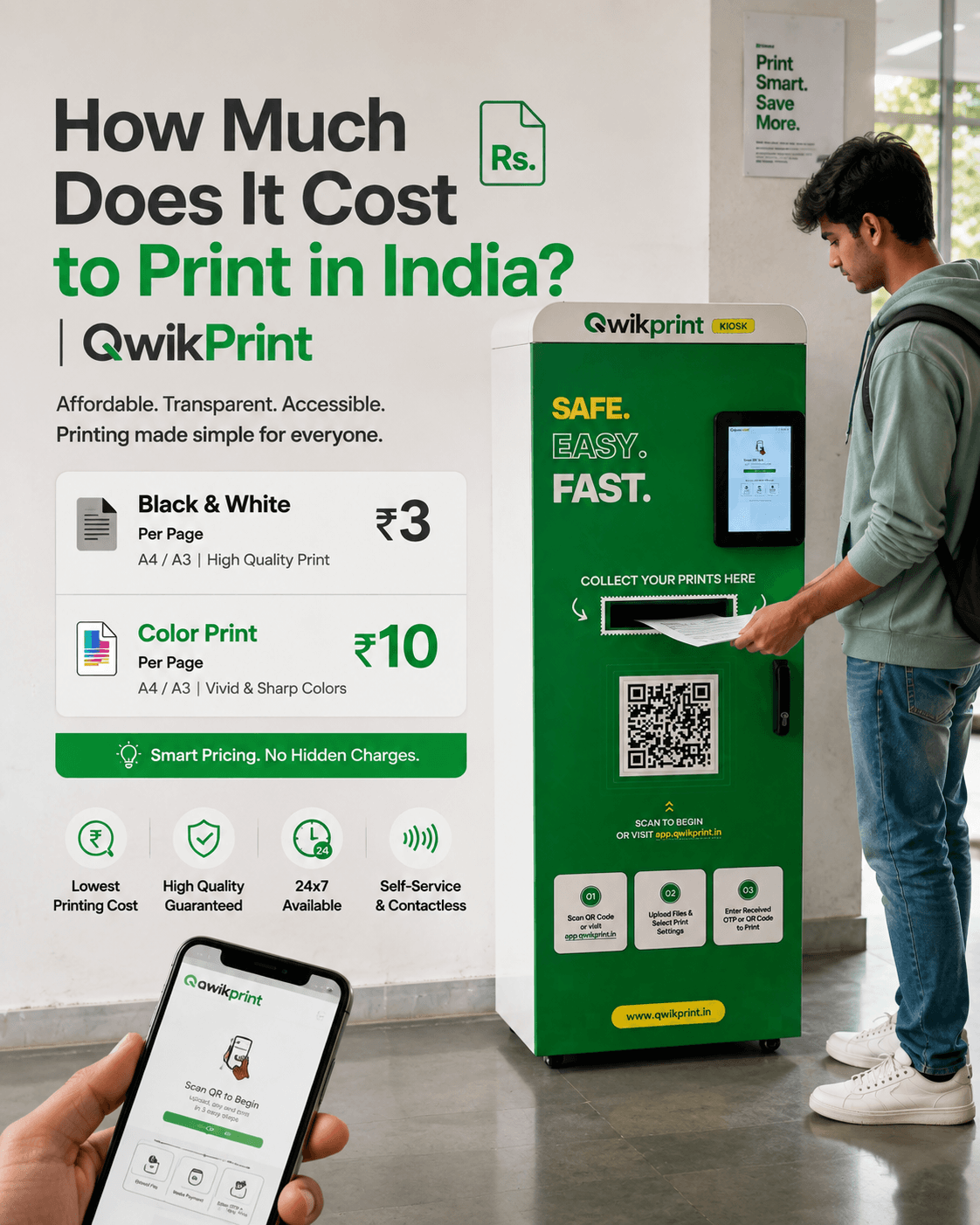
This is exactly the gap QwikPrint was built to close. Across all of its machines in Tamil Nadu, the price is the same, flat, and transparent: ₹3 for black and white, ₹10 for colour — with no first-page tricks, no location-based gouging, and no "no other option" markup. No minimum-charge trap, no delivery fees, and no surge pricing either — just a flat ₹3 and ₹10, on the spot.
You pay the same fair rate whether you're on a city campus or a residential one. And because QwikPrint is fully self-service, you also skip the queue and the miscommunication — you choose your own settings, pay, and collect your print in seconds, 24/7. Fair pricing and genuine convenience, in one machine.
Frequently Asked Questions
How much does it cost to print one page in India?
A single black and white print typically costs between ₹3 and ₹15 depending on the location, with ₹3 being the realistic minimum. Colour usually costs ₹10 or more. Prices are highest near government offices, courts, and isolated campuses.
Why is printing so expensive near government offices?
Because those shops have a captive audience with few alternatives nearby. Print shops beside RTO and court offices often charge a flat ₹15 for a single black and white copy, simply because customers have nowhere else to go.
Is printing really cheaper than photocopying?
Not usually. People often confuse the two — bulk photocopying (xerox) of a physical page can be cheap, but printing a shared digital document almost always starts at around ₹3 per page anywhere in India.
Are online printing apps like Blinkit cheaper?
Usually not. While they're convenient for home delivery, you pay extra delivery charges and possible surge pricing, and they can't deliver inside places like government offices, exam halls, or many campuses where you often need prints on the spot.
What is the cheapest way to print in India?
Look for transparent, flat-rate pricing without hidden first-page or minimum charges. QwikPrint, for example, charges a consistent ₹3 for black and white and ₹10 for colour across all its machines, with no surprise markups.
Final Thoughts
Printing in India costs whatever the shop in front of you decides — anywhere from ₹3 to ₹15 for the same black and white page, with first-page tricks, ₹20 minimums, and location markups making it worse. Even the convenient online apps add delivery fees and can't reach where you often need them. The demand is huge and constant; what's been missing is fair, predictable pricing. That's the whole idea behind a transparent, flat-rate self-service machine: the same honest price, wherever you are, with none of the tricks.
Next time you need a printout, you'll know exactly what you should be paying — and that's printing done right.
Want fair, flat-rate printing near you? Find your nearest QwikPrint machine at app.qwikprint.in.
Interested in running a fairly-priced printing machine of your own? See franchise details at qwikprint.in.