Media
4 min

Is a Printing Business Still Profitable in India in 2026?
With everything going digital, it's a fair question: is a printing business still worth it in 2026, or is it a fading idea? The short answer is that printing is very much still profitable in India — but the way you run it makes all the difference. The traditional xerox shop is struggling, while a new, automated model is thriving. This guide breaks down whether a printing business is still profitable, why demand isn't going anywhere, and what actually separates a profitable printing business today from a dying one.
Is a Printing Business Profitable in India in 2026?
Yes, a printing business is still profitable in India in 2026 — but mainly in its automated form. Printing demand remains constant thanks to students, job seekers, and government paperwork, but the traditional staffed shop faces thin margins from rent and salaries. An automated self-service printing kiosk stays profitable because it runs 24/7 with no staff and very low running costs.
"Isn't Everything Digital Now?" — Why Printing Demand Isn't Dying
The biggest doubt about printing is the assumption that nobody prints anymore. On the ground, that's simply not true. Every single day across India, people need to print:
College assignments, project reports, and question papers
Resumes, job applications, and admit cards
Government forms, Aadhaar copies, and legal documents
Competitive exam materials and study notes
Tickets, receipts, and ID proofs
This demand is constant, recurring, and largely recession-proof. In fact, many institutions are required to provide printing facilities, and government processes still run on paper. As long as colleges, offices, and government departments ask for printed documents — and they will for a long time — the demand for printing stays strong. The need never went away; only the best way to serve it has changed.
Why Traditional Printing Shops Are Struggling
So if demand is strong, why do so many people think printing isn't profitable? Because they're looking at the traditional model — and that model genuinely is under pressure. Here's why margins have thinned for the classic xerox shop:
Staff salaries — a full-time operator is the single biggest recurring cost.
Shop rent and deposits — a heavy fixed cost every month, regardless of sales.
Fixed hours — the shop earns only when it's open and staffed, missing nights and holidays.
Idle periods — during lulls (like exam-time gaps in student movement), a staffed shop still costs money while earning little.
Thin per-print margins — once rent and salaries are paid, what's left from ₹2–3 prints is small.
The traditional shop isn't unprofitable because demand dropped. It's unprofitable because its costs are too high for the price of a print. That's the real problem — and it's exactly what the automated model solves.
Why the Automated Model Is Profitable
An automated self-service printing kiosk keeps all the demand of a printing business while stripping away the costs that were killing the margins. This is where printing is genuinely profitable in 2026:
No staff — the machine is the operator, so there are no salaries at all.
No big rent — it fits in a small space, so there's no shop rent or heavy deposit.
Runs 24/7 — it earns overnight, on Sundays, and during holidays, when a staffed shop sits closed.
No idle-cost problem — with no salary or rent to cover, quiet periods don't drain money.
Low running costs — mainly just paper and toner, so most of each print is profit.
Same demand, a fraction of the cost. That's what turns thin margins into a genuinely profitable business.
The Numbers: What a Printing Kiosk Can Earn
Here's the honest math for an automated kiosk in a good, high-footfall location:
Volume: around 1,000–1,500 prints a day
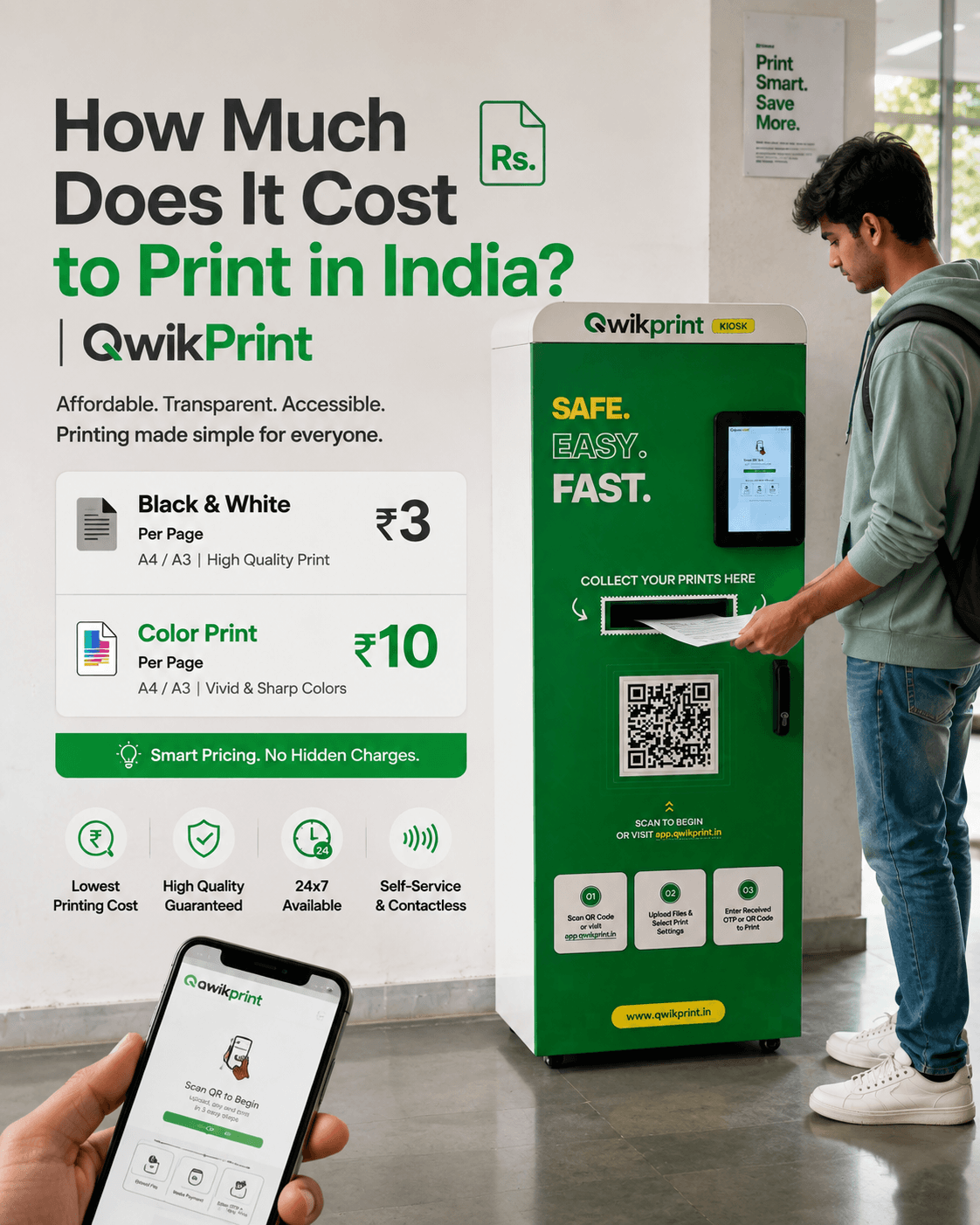
Rates: ₹2–3 per black & white print, ₹10 per colour print
Revenue: roughly ₹1–1.5 lakh a month
Running costs: mainly paper and toner — so a large share is profit
ROI: with QwikPrint, the Mini model can pay back its cost in under 3 months, and the Pro in 3-5 months
Because the costs that burden a traditional shop simply aren't there, the automated model converts the same steady demand into real, recurring profit.
(ROI depends heavily on location and footfall — a busy campus performs very differently from a quiet spot.)
What Makes a Printing Business Profitable in 2026
Pulling it together, the printing businesses that thrive today share a few things in common. If you're considering one, look for:
A location with constant demand — campuses, coaching centres, hospitals, and government offices.
Low running costs — the less you spend on rent and staff, the more each print earns.
Long operating hours — 24/7 availability captures demand a fixed-hour shop misses.
Minimal staff — automation removes the biggest recurring cost.
A proven, reliable system — so the machine actually runs without constant intervention.
Tick these, and printing isn't just still profitable — it's one of the better low-effort businesses you can run.
Final Thoughts
So, is a printing business still profitable in India in 2026? Absolutely — but only if you run it the right way. The demand for printing is as strong as ever; what's changed is that the profit has moved from the old staffed shop to the automated, self-service model. By cutting out staff and rent while running around the clock, an automated printing kiosk turns constant demand into genuine, recurring income. Printing isn't dying — for the right model, it's just getting started.
Ready to run a printing business built for 2026? See models, pricing, and franchise details at qwikprint.in.